
Edgar County Court Records After a Jail Arrest
Edgar County criminal cases are handled in the Illinois Fifth Judicial Circuit. After an arrest in Edgar County, the person may be booked at Edgar County Jail, and the State's Attorney reviews police reports before filing criminal or traffic charges in Circuit Court. Those filed charges become the court records for the case. The official court pathway runs through the Edgar County Courthouse at 115 West Court Street in Paris, the Circuit Clerk's case records, and the online case-search link used by the court pages.
The jail side and the court side answer different questions. Jail inmate records are used for custody, booking, release, and local jail status. Jail mugshots concern booking photos and arrest-information requests. Court records after an arrest show what the prosecutor filed, whether a case is pending, what hearings have occurred, and whether a charge was dismissed, amended, reduced, pleaded, or decided.
The Illinois Courts directory for Edgar County Courthouse, the Fifth Judicial Circuit Edgar County page, and the Edgar County Circuit Clerk page are official local entry points for courthouse and online-record information.
That courthouse source matters because jail arrest information does not replace the Circuit Clerk's record. For official copies, older files, docket questions, and case-number help, the Edgar County Circuit Clerk remains the direct records office.
How to Find Edgar County Court Records After an Arrest
Official Edgar County court pages link case lookup to Judici for online records. Research reached the Edgar County Judici case-search URL, but the public page presented a human-verification barrier, so the complete search-field set could not be confirmed through static inspection. If Judici is available in a browser, search by the defendant's name or a known case number, then compare the case entry against jail and release information.
- Open the Edgar County case-search link from the Illinois Courts directory, the Fifth Judicial Circuit Edgar County page, or Judici's Edgar County court page.
- Search by defendant name or case number when the form is available. The Edgar County court parameter identified in research is IL023015J.
- Open the matching case and review the charge list, filing date, court events, hearing dates, and disposition entries.
- Check each charge separately. One arrest can produce multiple counts with different statuses.
When online access is blocked or a case does not appear yet, contact the Edgar County Circuit Clerk, Angela R. Barrett, at 217-466-7447. The Circuit Clerk page states that the office maintains Circuit Court records for civil and criminal cases. For immediate custody, call Edgar County Jail at 217-465-4199 or the Sheriff's Office at 217-465-4166, because a person may be booked before court processing creates a searchable docket.
The Judici Edgar County case-search page was linked by official court pages but showed a verification screen during research.
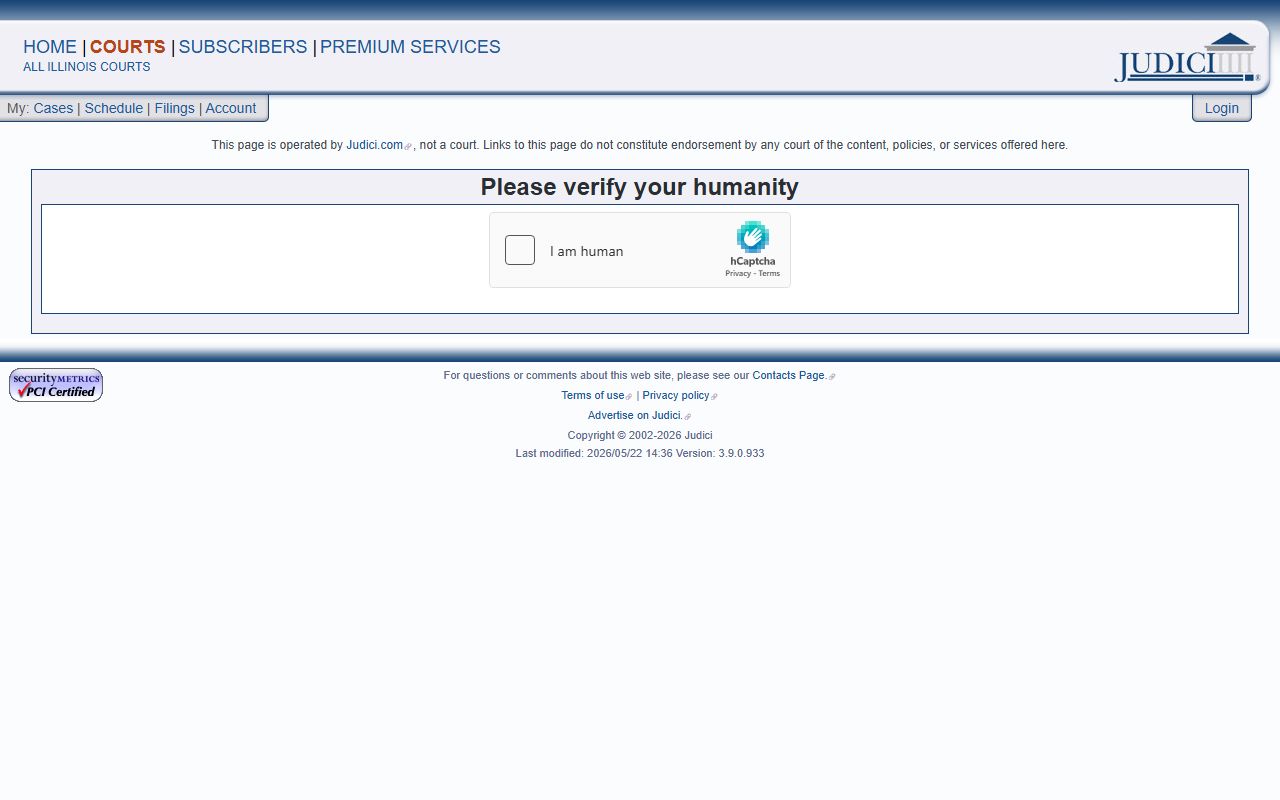
The verification barrier is an access limit, not proof that a case does not exist. A direct clerk inquiry is the safer fallback when a hearing date, official copy, or exact charge status is needed.
How Charges Get Filed After an Arrest: Complaint, Information, and Indictment
Booking charges are not always the final court charges. Police may arrest on probable cause and provide reports to the State's Attorney. In Edgar County, State's Attorney Philip Dobelstein's office commences and prosecutes criminal and traffic cases in Circuit Court. The charging document is the point where the arrest moves into a court record that the clerk can maintain and the judge can act on.
| Complaint | Information | Indictment | |
|---|---|---|---|
| Filed By | Often an officer or prosecutor | State's Attorney | Grand jury |
| Common For | Initial criminal allegations and many misdemeanor matters | Many felony prosecutions after review | Serious felony matters or cases presented to a grand jury |
| Starts | The court case or an early charging stage | The prosecuted court case | The prosecuted court case after grand-jury action |
The Edgar County State's Attorney page lists the office at 115 W Court St, Room S, Paris, Illinois 61944, and the office phone is 217-466-7456. That office is not the general case-record counter; it is the prosecuting office. The Circuit Clerk is the proper contact for docket records and official copies.
Charge Status in Court Records After an Arrest
Charge status can change several times after an arrest. A booking entry may name an arrest allegation, while the court record may later show a filed charge with a different statute, a reduced offense, an added count, or a dismissal. Read each count individually and avoid treating the first jail entry as the final court result.
| Status | What It Means |
|---|---|
| Pending | The charge remains open and has not reached a final disposition. |
| Amended / Reduced | The prosecutor changed the filed count, charge level, wording, or statute cited. |
| Dismissed | The court dismissed the count or the prosecution did not proceed on that count. |
| Nolle Prosequi | The prosecution declined to continue that charge, often shown as a dismissal-type disposition. |
Pretrial Release After an Arrest
Illinois no longer uses cash bail as the ordinary framework for new criminal cases. The statewide pretrial release system that began September 18, 2023, requires courts to consider release conditions and detention petitions instead of routine cash-bail posting. Older words such as bond, bail, cash bond, and surety bond still appear in public speech and older records, but current Edgar County court records should be read through the modern pretrial release and detention framework.
| Release Term | How It Works in Current Context |
|---|---|
| Pretrial release | The court allows release with conditions designed to address appearance and public-safety concerns. |
| Detention petition | The State asks the court to hold a defendant pretrial under Illinois law. |
| Recognizance / promise to appear | The person is released based on court-ordered obligations without secured money bail. |
| Hold or detainer | Another warrant, parole matter, federal issue, ICE issue, or outside agency can prevent release even if a local case changes. |
No official Edgar County bond-payment page was located in the research. For release-order status, call the jail or Sheriff's Office, then verify the case docket or contact the Circuit Clerk if a court order needs confirmation.
Warrants That Lead to an Arrest
No official Edgar County Sheriff active-warrant search, warrant list, or most-wanted page was located on the county or sheriff website. Warrant questions should be handled through the Sheriff's Office, the Circuit Clerk, an attorney, or an in-person courthouse inquiry. A warrant can appear in a court record as a case event, failure-to-appear entry, or judge's order, but online access depends on the case-search portal and any restrictions on the file.
An arrest warrant authorizes law enforcement to take a person into custody. A bench warrant often follows failure to appear or failure to comply with a court order. A search warrant is different because it authorizes a search of property, not an inmate lookup. Other-agency warrants and federal holds can keep someone in custody after a local Edgar County arrest even when the local court issue is resolved.
Charges vs. Convictions
An arrest and a charge are accusations, not proof of guilt. A conviction occurs only after a guilty plea, finding, or verdict. Court records after a jail arrest should be read with that sequence in mind, especially when a case is still pending or some counts have been dismissed while others remain open.
| Charge | Conviction | |
|---|---|---|
| Stage | Accusation after arrest and filing | Final result after plea, finding, or verdict |
| Burden of Proof | Probable cause or charging standard | Beyond a reasonable doubt for criminal conviction |
| Public Record | Often public unless sealed, juvenile, or otherwise restricted | Often public unless sealed, expunged, or restricted by law |
Sealed vs. Expunged Arrest Records
Illinois law provides routes to seal or expunge eligible records, but eligibility depends on the charge, disposition, waiting period, prior history, and court order. Sealing limits public access. Expungement is stronger and may result in records being destroyed or treated as if the arrest did not occur for many public-record purposes. The Circuit Clerk's record and the arresting agency's record are separate, so a court order may need to be directed to more than one holder of records.
| Sealed | Expunged | |
|---|---|---|
| Visibility | Hidden from most public access | Removed or treated as not existing for many public purposes |
| Law Enforcement | May retain limited access under Illinois rules | Access is more limited and depends on the order and statute |
| Eligibility | Depends on Illinois sealing law and the case disposition | Often tied to dismissals, acquittals, eligible supervision outcomes, or other qualifying results |
Background Check Considerations
Casual court lookup is not the same as a legally compliant background check. Employers, landlords, insurers, lenders, and other regulated users must follow the Fair Credit Reporting Act and any applicable Illinois law. Court records can be incomplete, delayed, sealed, expunged, or mistaken for another person with a similar name, so regulated screening should not rely on a quick name search.
Important: Regulated screening requires a compliant consumer reporting agency; public-record summaries are not for FCRA-covered use.
Restricted Court Records After an Arrest in Edgar County
Some court records after an arrest may not be publicly available. Juvenile matters, sealed cases, expunged records, protected victim information, active investigative material, and certain dismissed or restricted records can be withheld from public access. Illinois FOIA also contains exemptions, and court access rules are separate from ordinary county-record requests.
Use FOIA for sheriff, jail, arrest-report, and booking-photo requests when those records are not posted. Use the Circuit Clerk for court records, docket entries, official copies, and case numbers. Use IDOC for sentenced state prisoners, BOP for sentenced federal prisoners, ICE for immigration detention, and Illinois VINE for custody or case notifications where available.
Public Record Search
Sponsored Results